
Google Ads remains one of the most effective platforms for reaching potential customers while they are actively searching for products, services or business solutions. For companies targeting customers in the United States, United Kingdom and United Arab Emirates, a well-managed Google Ads campaign can generate qualified leads, online sales, consultation requests, phone calls and measurable business growth.
However, simply creating a campaign, selecting a few keywords and setting a daily budget does not guarantee profitable results. Incorrect conversion tracking, weak account structure, unsuitable bidding strategies, poor landing pages and uncontrolled automation can quickly consume the advertising budget without producing meaningful revenue.
Google Ads increasingly relies on machine learning, automated bidding and conversion data. When the data provided to the platform is inaccurate, the system may begin optimizing campaigns toward low-quality enquiries, irrelevant traffic or actions that do not contribute to revenue.
Whether you manage campaigns internally or work with a professional Google Ads management company, avoiding the mistakes covered in this guide can help improve campaign efficiency, lead quality and return on advertising investment.
Important: A campaign generating more clicks or cheaper leads is not automatically successful. The real objective is to generate qualified customers, profitable sales and measurable business growth.
Why Google Ads Campaigns Underperform
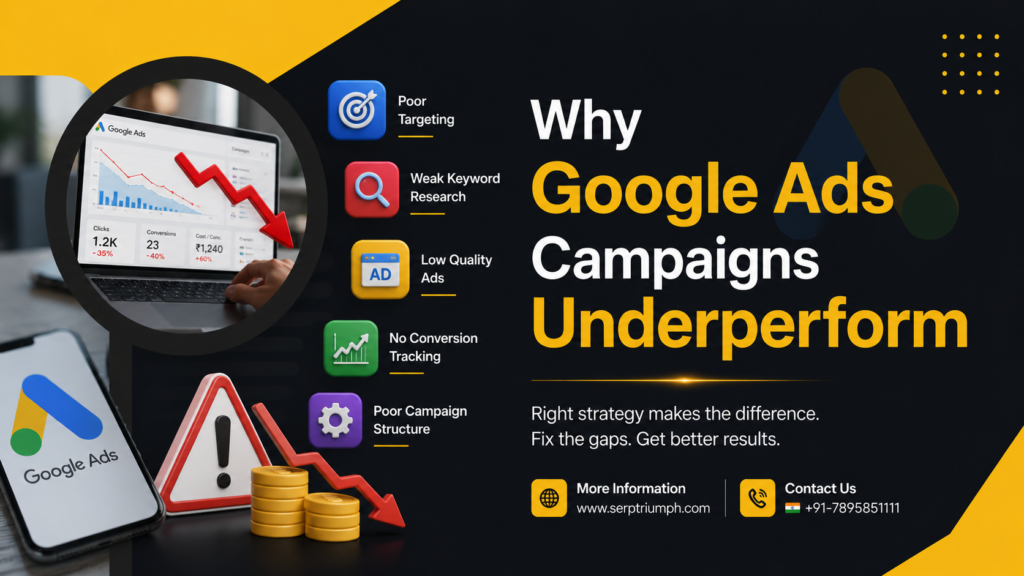
Most unsuccessful campaigns do not fail because Google Ads is ineffective. They fail because the campaign structure, tracking setup and business objectives are not aligned.
For example, a campaign may report 100 conversions at a low cost. However, if most of those conversions are newsletter sign-ups, accidental phone calls or unqualified enquiries, the campaign is not producing meaningful commercial value.
A professional PPC advertising agency should evaluate success using qualified leads, sales conversion rates, revenue, customer acquisition costs and return on ad spend—not clicks and impressions alone.
The following mistakes can prevent businesses from achieving profitable Google Ads results across competitive markets such as the USA, UK and UAE.
1. Running Campaigns Without Complete Conversion Tracking
Incomplete or inaccurate conversion tracking is one of the most expensive Google Ads mistakes a business can make.
Google Ads needs reliable conversion data to understand which keywords, advertisements, audiences, devices and locations generate valuable business actions. Without this information, automated bidding may optimize campaigns toward website traffic rather than genuine customers.
Important conversion actions may include:
- Contact form submissions
- Online purchases
- Appointment bookings
- Quote requests
- Phone calls from advertisements
- Phone calls from the website
- WhatsApp or live-chat enquiries
- Demo requests
- Free-trial registrations
- Qualified lead submissions
Tracking only website visits, page views or button clicks does not reveal whether your campaign is generating revenue.
Before increasing your advertising budget, test every important conversion action. Confirm that each event is recorded correctly in Google Ads and that duplicate conversions are not inflating the results.
Effective Google Ads conversion tracking provides the foundation for accurate bidding, reporting and campaign optimization.
2. Using Low-Value Actions as Primary Conversion Goals
Not every website interaction has equal business value. A person who scrolls through a page is not necessarily as valuable as someone who completes a purchase or requests a consultation.
Common low-value actions include:
- Page views
- Time spent on a page
- Scroll depth
- Newsletter subscriptions
- Brochure downloads
- Video views
- Clicks on non-commercial buttons
These actions can be useful for analysis, but they should not automatically receive the same importance as qualified enquiries, completed orders or booked appointments.
When low-intent interactions are used as major campaign goals, automated bidding may begin targeting users who are likely to complete easy actions instead of users who are likely to become customers.
Your primary conversion goals should be closely connected with revenue, qualified pipeline or customer acquisition.
3. Optimizing for More Leads Instead of More Profit
Many advertisers judge campaign success only by the number of leads or the cost per lead. Although these metrics are useful, they do not explain whether the leads are relevant, qualified or profitable.
Consider the following example:
| Campaign | Leads Generated | Cost Per Lead | Customers Acquired |
| Campaign A | 100 | Low | 3 |
| Campaign B | 30 | Higher | 12 |
Campaign B has a higher cost per lead but may generate considerably more revenue and profit.
Businesses should monitor:
- Lead qualification rate
- Sales acceptance rate
- Customer acquisition cost
- Lead-to-customer conversion rate
- Revenue generated per lead
- Return on ad spend
- Profit margin
- Customer lifetime value
Professional Google Ads campaign management should connect advertising activity with real sales and revenue outcomes.
4. Ignoring Offline Conversion Tracking
For B2B companies, real estate businesses, legal firms, healthcare providers, educational institutions and professional service companies, a customer may not purchase immediately after clicking an advertisement.
A potential customer may:
- Click a Google advertisement.
- Submit an enquiry form.
- Speak with the sales team.
- Attend a consultation or demonstration.
- Become a paying customer several days or weeks later.
If the final sale is not connected with the original advertisement, Google Ads cannot distinguish between a low-quality form submission and a profitable customer.
Importing qualified leads and completed sales from a CRM can help businesses understand which campaigns, keywords and advertisements generate real revenue.
This information can also help automated bidding identify users who resemble previous high-quality customers.
5. Treating Google Ads Automation as Fully Independent
Google Ads automation can analyze numerous signals, adjust bids and identify patterns faster than manual campaign management. However, automation still depends on the instructions and data provided by the advertiser.
Google Ads does not automatically understand:
- Your profit margins
- Your sales team’s capacity
- Your most valuable products or services
- The difference between qualified and unqualified enquiries
- Your preferred customer profile
- Your internal sales process
- Your country-specific business priorities
Depending entirely on automation can result in:
- Expansion into low-intent searches
- Higher spending on weak locations
- More low-quality leads
- Budget leakage across unsuitable placements
- Campaign objectives moving away from business goals
The strongest campaigns combine automated technology with strategic human oversight. A skilled Google Ads expert should guide the system, review lead quality and make adjustments according to business performance.
6. Creating a Weak or Overcomplicated Account Structure
Campaign structure influences how budgets, keywords, advertisements, bidding strategies and conversion data are managed.
Common account-structure mistakes include:
- Combining unrelated products or services in one campaign
- Creating too many campaigns with insufficient budgets
- Using one ad group for every keyword
- Mixing multiple countries in one campaign without a strategy
- Using identical advertisement copy for different services
- Sending every user to the same website page
- Using unclear campaign names
- Creating unnecessary campaign fragmentation
For example, a digital marketing business should not place “SEO services,” “website development” and “social media marketing” keywords inside one general ad group. Each service has a different audience, search intent, message and landing-page requirement.
A clear structure helps advertisers identify profitable services, control budgets and improve reporting accuracy.
7. Combining the USA, UK and UAE in One Campaign Without a Strategy
The United States, United Kingdom and United Arab Emirates are separate advertising markets. They have different currencies, customer behaviors, search habits, time zones, competition levels and average advertising costs.
Combining all three countries inside one campaign may make budget allocation and performance analysis difficult.
For better control, businesses should consider creating separate campaigns for:
- United States audiences
- United Kingdom audiences
- United Arab Emirates audiences
Separate campaigns allow advertisers to customize:
- Daily budgets
- Keyword targeting
- Advertisement language
- Location-specific offers
- Landing-page content
- Currency references
- Advertisement schedules
- Bidding strategies
- Phone numbers and contact options
| Target Market | Possible Keyword Example | Important Consideration |
| USA | Google Ads agency USA | State-level competition and multiple time zones |
| UK | PPC agency UK | Regional search language and GBP-based offers |
| UAE | Google Ads agency UAE | Emirate-level targeting and multilingual audiences |
Country-specific campaign management provides greater control and makes it easier to identify which market produces the strongest return on investment.
8. Using Incorrect Geographic and Location Targeting
Location targeting determines where advertisements can appear. Incorrect settings may cause campaigns to receive traffic from users outside the intended service area.
Advertisers should carefully review:
- Selected countries, states, cities or emirates
- Included and excluded locations
- Presence and location-interest settings
- User-location reports
- Search behavior by geographic area
- Conversion rates by region
- Cost per qualified lead by location
A business targeting the UAE may need separate location analysis for Dubai, Abu Dhabi, Sharjah and other relevant emirates. A company targeting the United States may need separate campaigns or adjustments for high-priority states. UK campaigns may require regional targeting based on the areas the business can serve.
The correct setup depends on whether your business serves customers nationally, regionally, locally or entirely online.
9. Selecting Keywords Without Understanding Search Intent
A keyword may appear relevant but still attract users who are not ready to purchase.
Search intent can generally be divided into different categories:
- Informational: The user wants to learn something.
- Commercial: The user is comparing solutions or providers.
- Transactional: The user is ready to take action or purchase.
- Navigational: The user is searching for a specific brand or website.
For example, the keyword “how does Google Ads work” has educational intent. The keyword “hire Google Ads agency” has stronger commercial intent.
Businesses focused on lead generation should prioritize keywords that indicate a clear need for a service, solution or provider.
High-intent keyword examples may include:
- Google Ads management services
- Google Ads agency USA
- PPC management services UK
- Google Ads agency UAE
- Google Ads agency Dubai
- International PPC agency
- Google Ads audit services
- Google Ads management company
- PPC campaign management services
Keyword selection should be based on business relevance, customer intent, competition and potential commercial value.
10. Using Keyword Match Types Without a Clear Strategy
Keyword match types control how closely a user’s search must relate to the keyword selected by the advertiser.
Using only broad match may increase reach, but it can also attract searches that are not closely connected with the offer. Relying only on exact match can restrict reach and limit keyword discovery.
A balanced keyword strategy may include:
- Exact match: For important, high-intent commercial keywords.
- Phrase match: For controlled expansion around relevant search intent.
- Broad match: When conversion tracking and campaign data are strong enough to support wider targeting.
Match-type decisions should be based on:
- Available conversion data
- Campaign budget
- Search volume
- Lead quality
- Market competition
- Negative keyword coverage
Match types should be reviewed regularly as campaigns collect more performance data.
11. Ignoring Search Terms and Negative Keywords
The keyword selected by an advertiser and the exact search typed by the user are not always the same. The search-terms report shows which user queries triggered advertisements.
Without regular analysis, campaigns may spend money on irrelevant searches containing terms such as:
- Free
- Jobs
- Salary
- Internship
- Course
- Training
- Certification
- Template
- Meaning
- Software login
For example, a company offering Google Ads management services may not want advertisements to appear for people searching for free Google Ads courses or Google Ads jobs.
Regular search-term analysis can help advertisers:
- Identify irrelevant searches
- Add negative keywords
- Discover new high-performing keywords
- Understand customer language
- Improve advertisement relevance
- Reduce wasted spending
Search-term analysis is one of the most important ongoing activities in professional PPC management.
12. Choosing a Bidding Strategy Without Enough Data
Automated bidding can improve performance, but the selected strategy must match the campaign objective and available data.
Common bidding mistakes include:
- Using conversion-focused bidding before tracking is tested
- Setting an unrealistic target cost per acquisition
- Setting an unrealistic target return on ad spend
- Using Maximize Conversions with low-value conversion goals
- Changing bidding strategies too frequently
- Increasing budgets aggressively during a learning period
- Using the same bidding strategy for every campaign
A new campaign may need time to collect sufficient information before strict performance targets can be applied.
The correct bidding strategy depends on:
- Campaign objective
- Conversion volume
- Average order value
- Sales cycle
- Profit margin
- Market competition
- Available budget
Bidding should support the business goal rather than operate as an isolated technical setting.
13. Automatically Applying Every Google Ads Recommendation
Google Ads recommendations can identify opportunities, but every suggestion should be evaluated according to the advertiser’s business objective.
Recommendations may include:
- Adding broad match keywords
- Increasing the campaign budget
- Changing the bidding strategy
- Adding automatically generated assets
- Expanding audience targeting
- Creating new campaign types
A recommendation may increase reach or platform activity, but it does not automatically guarantee better lead quality, revenue or profitability.
Before applying a recommendation, review:
- The expected impact
- Existing campaign performance
- Lead-quality data
- Available budget
- Business priorities
- Potential risks
Major campaign changes should not be implemented automatically without strategic review.
14. Combining Brand and Non-Brand Campaigns
Brand and non-brand searches represent different stages of the customer journey.
A person searching for your company name already knows your business. A person searching for “Google Ads agency USA” or “PPC agency UK” may still be comparing multiple providers.
Brand keywords often generate:
- Higher click-through rates
- Lower costs per click
- Higher conversion rates
- Lower costs per acquisition
When brand and non-brand keywords are combined, brand traffic can make overall campaign performance appear stronger than it actually is.
Separating both categories provides clearer reporting and helps advertisers understand the actual cost of acquiring new customers.
15. Using Generic or Repetitive Advertisement Copy
Your advertisement must give potential customers a clear reason to choose your business over competing providers.
Weak advertisements often use generic claims such as:
- Best service
- High quality
- Affordable prices
- Contact us today
- Trusted company
These statements do not explain what makes the offer different or valuable.
Effective advertisement copy should include:
- The main service or product
- A clear customer benefit
- A unique selling point
- A relevant offer
- A strong call to action
- Location or market relevance
- Language matching the landing page
Advertisement assets may highlight:
- Free account audits
- Transparent reporting
- Dedicated campaign management
- Conversion tracking
- Customized PPC strategies
- International campaign experience
Multiple headline and description variations should be tested over a meaningful period to identify which messages generate qualified conversions.
16. Sending Paid Traffic to a Weak Landing Page
A well-managed campaign cannot compensate for a confusing, slow or irrelevant landing page.
Common landing-page mistakes include:
- Sending every advertisement to the homepage
- Using a page that does not match the advertisement
- Having no clear call-to-action button
- Using a long or complicated enquiry form
- Providing limited trust information
- Having poor mobile usability
- Hiding contact information
- Using slow-loading images or scripts
- Offering inconsistent pricing or messaging
A person searching for “Google Ads agency UAE” should reach a page that clearly explains Google Ads campaign management—not a general page listing every service offered by the company.
Effective landing pages should include:
- A clear headline
- Relevant service information
- Customer benefits
- Trust signals
- Case studies or testimonials
- A simple enquiry process
- Frequently asked questions
- A strong call to action
Businesses that need conversion-focused website pages can explore SERP Triumph’s web design and development services.
17. Failing to Track Phone Calls
For many service-based businesses, phone calls are more valuable than website form submissions.
Legal firms, clinics, real estate companies, consultants, educational institutions and home-service providers frequently receive high-intent enquiries by phone.
Businesses should consider tracking:
- Calls made directly from advertisements
- Calls made after visiting the website
- Call duration
- Answered and missed calls
- Qualified phone enquiries
- Calls that become appointments or sales
Without call tracking, campaign reports may undervalue advertisements that are generating genuine customers.
Call-duration thresholds can also help separate serious enquiries from accidental or extremely short calls.
18. Measuring Lead Quantity Without Measuring Lead Quality
A high number of enquiries can appear impressive in a campaign report, but the sales team may still receive irrelevant, incomplete or unqualified leads.
Lead-quality analysis should include:
- Valid contact rate
- Lead qualification rate
- Sales acceptance rate
- Appointment-booking rate
- Proposal rate
- Customer conversion rate
- Revenue generated
Marketing and sales teams should use consistent definitions for qualified leads.
For example, a qualified lead may need to:
- Be located in the target market
- Have a genuine need for the service
- Meet the required budget
- Have authority to make a decision
- Provide valid contact details
Connecting lead-quality information with campaign data helps advertisers identify which keywords, advertisements and locations generate the strongest customers.
19. Dividing the Budget Equally Across Every Campaign
Every campaign does not deserve the same budget. Advertising spend should reflect commercial value, search demand, lead quality and growth opportunity.
Budget allocation should consider:
- Return on ad spend
- Cost per qualified lead
- Conversion rate
- Profit margin
- Impression-share limitations
- Market potential
- Sales capacity
- Seasonal demand
A campaign generating profitable customers may deserve additional investment. A campaign producing irrelevant enquiries may require optimization before receiving more budget.
However, advertisers should avoid making decisions based on extremely small data samples. Performance should be evaluated over a meaningful period.
20. Relying Exclusively on Performance Max Campaigns
Performance Max can help advertisers reach users across multiple Google advertising channels. However, relying entirely on one campaign type may reduce control and make performance analysis more difficult.
A broader campaign strategy may include:
- Search campaigns for high-intent keywords
- Performance Max campaigns for wider automated reach
- Remarketing campaigns for previous website visitors
- Shopping campaigns for e-commerce products
- Video campaigns for awareness and consideration
- Display campaigns for targeted remarketing
The correct campaign combination depends on the business model, target market, conversion goals and available creative assets.
Performance Max should support the overall strategy rather than automatically replace every existing campaign.
21. Making Major Campaign Changes Too Frequently
Constant campaign changes make it difficult to identify what is improving or damaging performance.
Frequent adjustments may include:
- Changing budgets every day
- Switching bidding strategies repeatedly
- Replacing advertisement copy too quickly
- Adding and removing keywords constantly
- Changing conversion goals during testing
- Restructuring campaigns without sufficient data
A better optimization process involves:
- Identifying one clear issue or opportunity.
- Making a controlled adjustment.
- Recording the date and reason for the change.
- Allowing sufficient data to accumulate.
- Comparing results before making another major change.
Strategic patience is essential in automated advertising systems. Decisions should be based on reliable trends rather than daily fluctuations.
22. Ignoring Attribution Windows and Conversion Delays
Not every customer converts immediately after clicking an advertisement.
A user may click an ad, visit the website several times, compare competitors and complete a purchase days later. B2B services and high-value purchases may have even longer decision-making periods.
Making campaign decisions before conversions are fully reported can result in:
- Pausing profitable keywords
- Reducing effective campaign budgets
- Replacing successful advertisements too early
- Misjudging return on investment
- Interrupting automated learning
Advertisers should understand the typical customer journey and allow enough time for conversions and offline sales data to appear.
23. Depending Exclusively on Google Ads
Google Ads can capture existing customer demand, but it should not operate separately from the rest of the digital marketing strategy.
A complete growth strategy may combine:
- Search engine optimization services for sustainable organic visibility
- Social media marketing services for brand awareness and engagement
- Content marketing for authority and education
- Email marketing for lead nurturing
- Conversion-focused website development
- Remarketing for previous website visitors
- Paid social media campaigns
Google Ads can generate immediate visibility, while SEO and content marketing can support long-term organic traffic. Social media can build awareness before potential customers begin searching.
Businesses achieve stronger results when paid advertising is part of an integrated customer-acquisition strategy.
Google Ads Audit Checklist
| Area to Review | Common Problem | Recommended Action |
| Conversion Tracking | Important enquiries or sales are not recorded | Test forms, calls, purchases and booking events |
| Conversion Goals | Low-value actions influence automated bidding | Prioritize qualified leads, appointments and sales |
| Country Targeting | USA, UK and UAE performance is combined | Create country-specific campaigns where appropriate |
| Location Settings | Clicks come from irrelevant locations | Review targeting options and user-location reports |
| Search Terms | Budget is spent on irrelevant searches | Add negative keywords regularly |
| Advertisement Copy | Headlines are generic or repetitive | Test benefits, offers and strong calls to action |
| Landing Pages | The page does not match the advertisement | Create dedicated, mobile-friendly service pages |
| Lead Quality | Reports focus only on the total number of leads | Connect campaign data with CRM and sales results |
| Budget Allocation | Every campaign receives equal spending | Prioritize profitable, high-intent campaigns |
How SERP Triumph Supports International Google Ads Campaigns
Successful Google Ads management requires more than launching advertisements. It involves keyword research, campaign structuring, conversion tracking, advertisement testing, landing-page analysis, search-term monitoring, bidding optimization and transparent reporting.
SERP Triumph provides data-driven digital marketing and paid advertising solutions for businesses seeking measurable growth.
Our Google Ads management services can support businesses targeting customers across the USA, UK and UAE through:
- Campaign planning and setup
- Country-specific targeting
- Keyword research
- Negative keyword management
- Advertisement copywriting
- Conversion tracking
- Landing-page recommendations
- Bid and budget optimization
- Search-term analysis
- Performance reporting
Every strategy should be based on the company’s target market, customer journey, budget and commercial objectives.
Is Your Google Ads Budget Generating Profitable Results?
Get your campaigns reviewed by SERP Triumph’s paid advertising team. Identify wasted spending, conversion-tracking gaps and opportunities to generate better-quality leads across the USA, UK and UAE.
Request a Google Ads Consultation
Frequently Asked Questions
What is the biggest Google Ads mistake businesses make?
One of the biggest mistakes is running campaigns without accurate conversion tracking. Without reliable conversion data, Google Ads may optimize toward low-value website actions rather than qualified enquiries, purchases or appointments.
Should the USA, UK and UAE be targeted in the same campaign?
Not always. Separate campaigns can provide better control over budgets, keywords, currencies, advertisement schedules, landing pages and performance reporting. The correct structure depends on the business, campaign budget and target audience.
How can businesses reduce wasted Google Ads spending?
Businesses can reduce wasted spending by improving conversion tracking, reviewing search terms, adding negative keywords, refining geographic targeting, improving landing pages and measuring qualified leads rather than total enquiries.
Should a business use Search campaigns or Performance Max?
The correct campaign type depends on the advertising goal. Search campaigns offer strong control over high-intent keywords, while Performance Max can extend reach across multiple Google advertising channels. Many businesses benefit from using a strategic combination.
How much should a business spend on Google Ads?
There is no universal Google Ads budget. The required investment depends on keyword competition, market size, service value, conversion rate, customer acquisition target and business goals. Campaigns should be tested before budgets are increased significantly.
Can Google Ads and SEO be used together?
Yes. Google Ads can provide immediate visibility, while SEO can build sustainable organic traffic over time. Using both channels can improve overall search visibility, keyword insights and customer acquisition.
Why is lead-quality tracking important?
Lead volume alone can be misleading. Tracking qualified leads helps identify which keywords, campaigns and advertisements generate genuine potential customers and revenue.
Why are negative keywords important?
Negative keywords prevent advertisements from appearing for irrelevant searches. They can reduce wasted clicks and help campaigns focus on users who are more likely to become customers.
Conclusion
The most damaging Google Ads mistakes are usually caused by inaccurate tracking, weak targeting, poor account structure and decisions based only on surface-level metrics.
Businesses should not judge campaign success only through clicks, impressions or inexpensive enquiries. A successful campaign should attract relevant customers, support the sales process and contribute measurable revenue.
Accurate conversion tracking, country-specific campaign planning, disciplined keyword management, effective location targeting, relevant landing pages and regular lead-quality analysis create the foundation for profitable Google Ads performance.
Businesses searching for a Google Ads agency in the USA, PPC agency in the UK, Google Ads agency in the UAE or an experienced international PPC agency can explore SERP Triumph’s professional campaign-management solutions.
Contact SERP Triumph to discuss your advertising goals and request a customized Google Ads strategy.