
Artificial Intelligence is transforming how people search online. Instead of scrolling through ten blue links, users now receive direct, conversational answers generated by AI platforms such as Google AI Overviews, ChatGPT Search, Microsoft Copilot, Gemini, and Perplexity AI. This major shift has introduced a new discipline known as Generative Engine Optimization (GEO). While traditional SEO focuses on improving rankings in search engine results pages (SERPs), GEO focuses on making your content understandable, trustworthy, and valuable enough to become part of AI-generated answers. Businesses that start optimizing for AI search today will gain a significant competitive advantage over those relying only on conventional SEO techniques. At SERP Triumph, we believe GEO is not replacing SEO—it is expanding it. Successful digital marketing now requires optimizing for both search engines and AI-powered answer engines.
What is Generative Engine Optimization (GEO)?
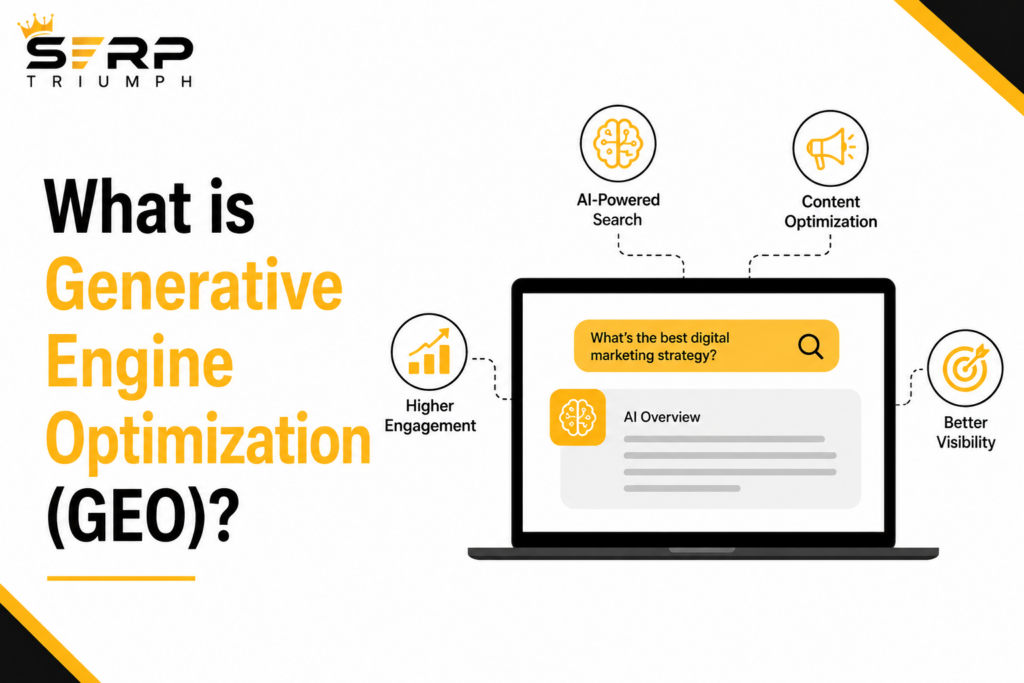
Generative Engine Optimization (GEO) is the process of optimizing digital content so that Artificial Intelligence search engines can easily understand, trust, summarize, and reference it while generating responses to user queries. Unlike traditional SEO, where the objective is to secure a high-ranking position in Google Search, GEO aims to become part of the answer itself. Modern AI platforms analyze information differently. They do not simply match keywords—they evaluate context, expertise, topical authority, semantic relationships, factual accuracy, and structured information before selecting content for AI-generated responses. This means businesses must create content that is comprehensive, reliable, and genuinely helpful.
For example, if someone asks ChatGPT:
“What is the best SEO strategy for AI Search?”
Instead of displaying a list of websites, AI generates one detailed response by combining information from trusted sources. Your goal with GEO is to make your website one of those trusted sources.
How AI Search Engines Work
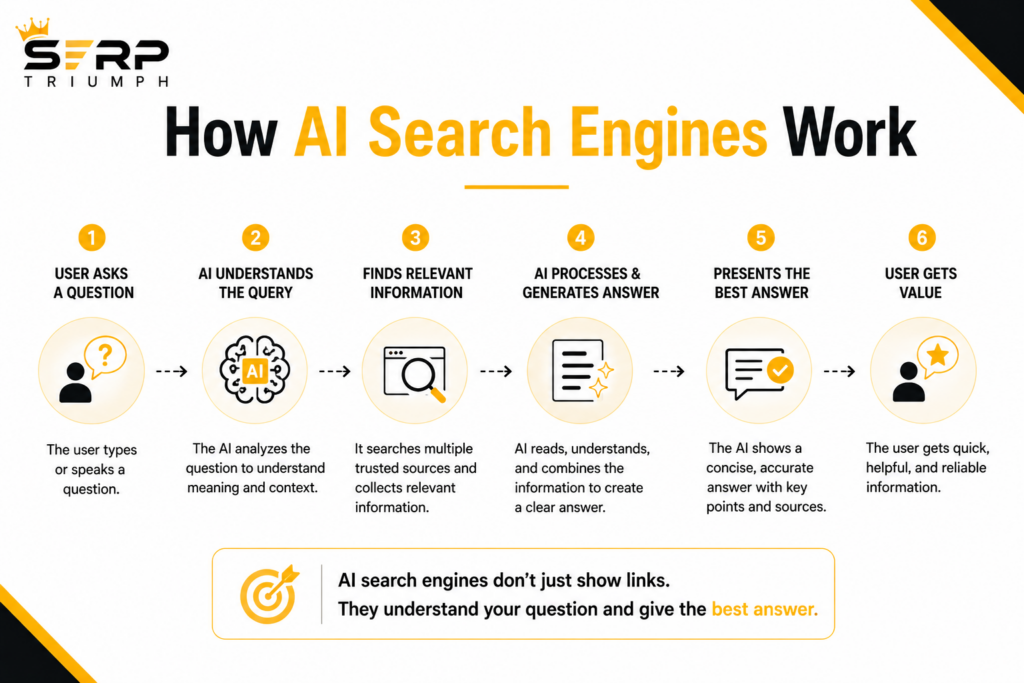
AI-powered search engines use Large Language Models (LLMs), Retrieval-Augmented Generation (RAG), semantic search, and real-time indexing to understand user intent beyond simple keyword matching. Instead of ranking pages solely based on backlinks or keyword density, AI systems evaluate multiple trust signals before selecting content.
Major Signals Used by AI Search
- Content depth and completeness
- Entity relationships
- Author expertise
- Website authority
- Structured data (Schema.org)
- Freshness of content
- User engagement signals
- Contextual relevance
- Brand mentions across the web
- Semantic coverage of a topic
This evolution means businesses need to focus less on writing for algorithms and more on producing authoritative resources that answer user questions comprehensively.
Traditional SEO vs Generative Engine Optimization
| Traditional SEO | Generative Engine Optimization (GEO) |
| Targets search rankings | Targets AI-generated answers |
| Keyword focused | User intent focused |
| Backlinks are primary ranking factor | Authority + Context + Trust matter most |
| Optimizes for Google Search | Optimizes for multiple AI platforms |
| Measures organic traffic | Measures AI visibility and citations |
| Focuses on ranking pages | Focuses on becoming an AI reference |
Although SEO fundamentals remain important, GEO introduces additional layers such as semantic optimization, entity optimization, conversational content, and machine-readable formatting. Businesses that combine both approaches achieve the strongest long-term visibility.
Why Generative Engine Optimization Matters More Than Ever
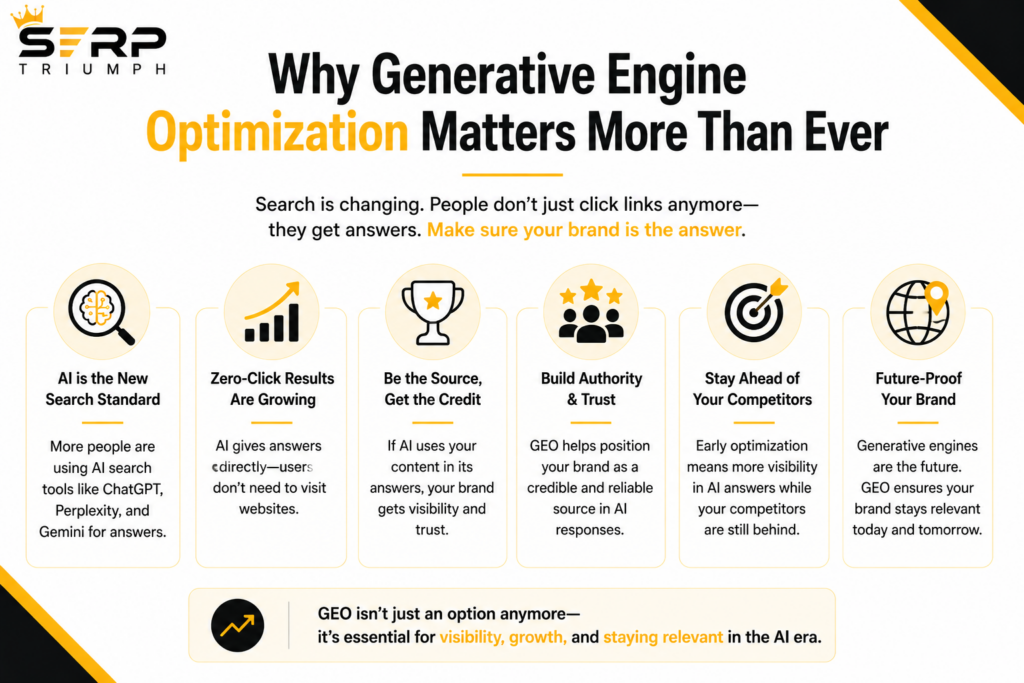
AI search adoption is accelerating rapidly. Millions of users now rely on AI assistants instead of traditional search engines for research, shopping, comparisons, software recommendations, travel planning, healthcare information, and business services. As Google expands AI Overviews and conversational search experiences, websites that fail to adapt may experience declining organic click-through rates despite maintaining strong rankings.
GEO ensures that your brand remains visible even when users never click traditional search results. Being cited inside AI-generated responses builds credibility, trust, and brand awareness while increasing the likelihood of qualified traffic and conversions.
Strengthen Your Overall SEO Strategy
Generative Engine Optimization works best when supported by a strong SEO foundation. Before optimizing for AI search, ensure your website follows technical SEO best practices, provides valuable content, and delivers an excellent user experience. Explore our comprehensive SEO Services to build a solid foundation that improves both traditional rankings and AI visibility.
A fast, responsive website also plays a crucial role in GEO. Learn how our Web Development Services help create technically optimized websites that AI search engines can easily crawl and understand.
Google AI Overviews: The Biggest Shift in Search
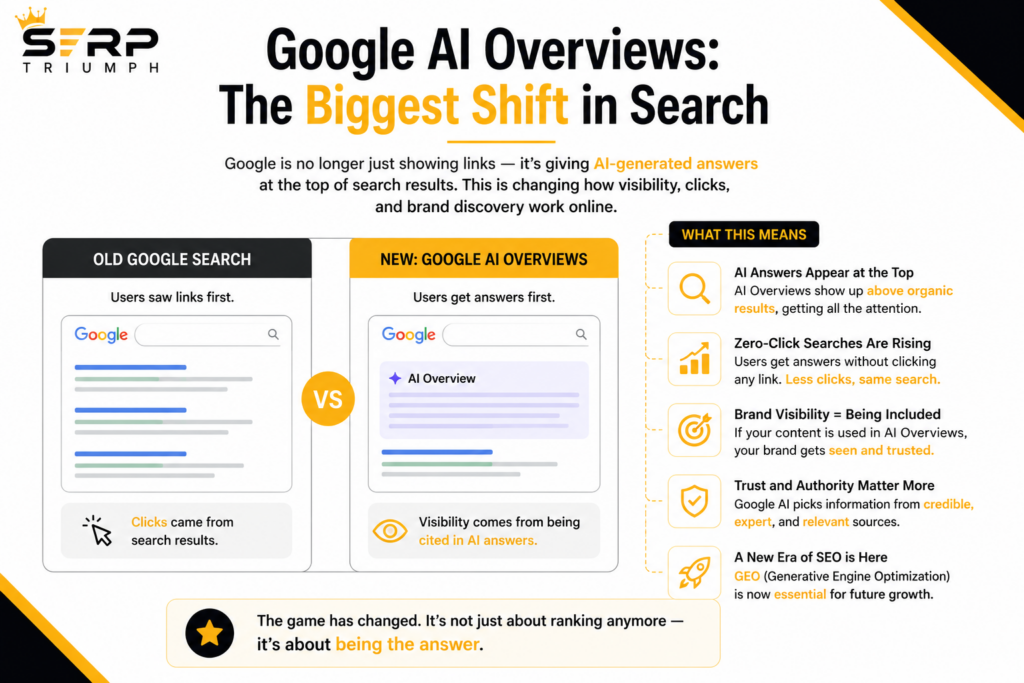
Google AI Overviews have fundamentally changed how users interact with search results. Instead of presenting only a list of webpages, Google now generates AI-powered summaries that answer user questions instantly while citing trusted sources. For businesses, this means ranking #1 is no longer the only goal. Your content should also be optimized to become one of the trusted references that Google includes within its AI-generated responses.
To improve your chances of appearing in AI Overviews, your content should:
- Answer questions clearly and directly.
- Cover topics comprehensively instead of targeting a single keyword.
- Include structured headings and logical content flow.
- Demonstrate real expertise and industry knowledge.
- Use structured data wherever applicable.
- Maintain factual accuracy with regularly updated information.
Google increasingly rewards websites that combine technical excellence with trustworthy, experience-based content. Brands that consistently publish authoritative resources are more likely to earn AI citations over time.
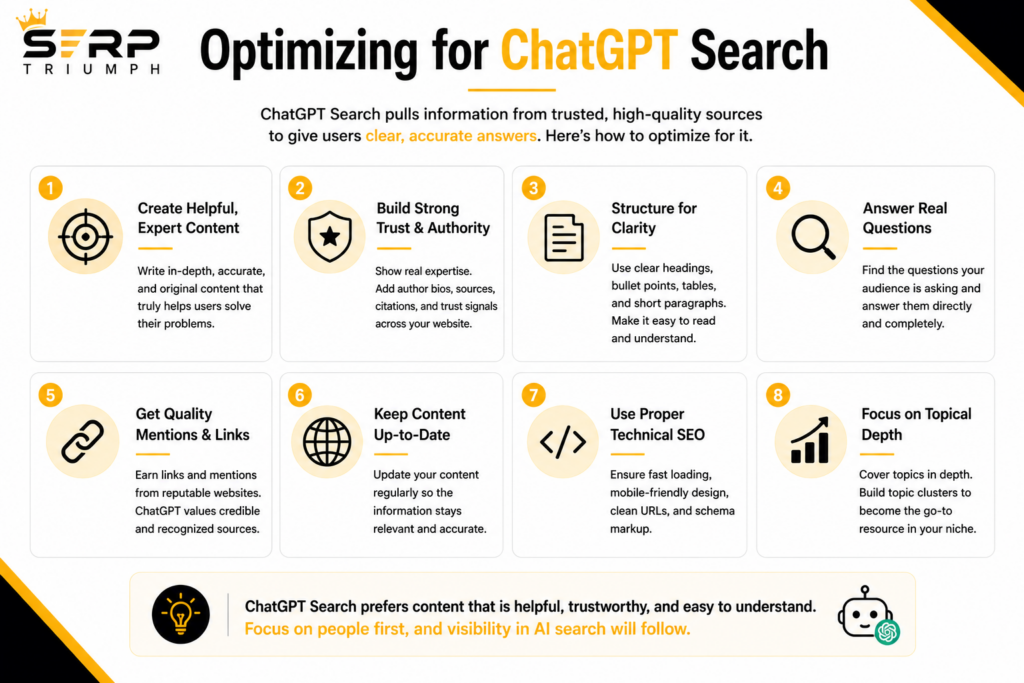
Optimizing for ChatGPT Search
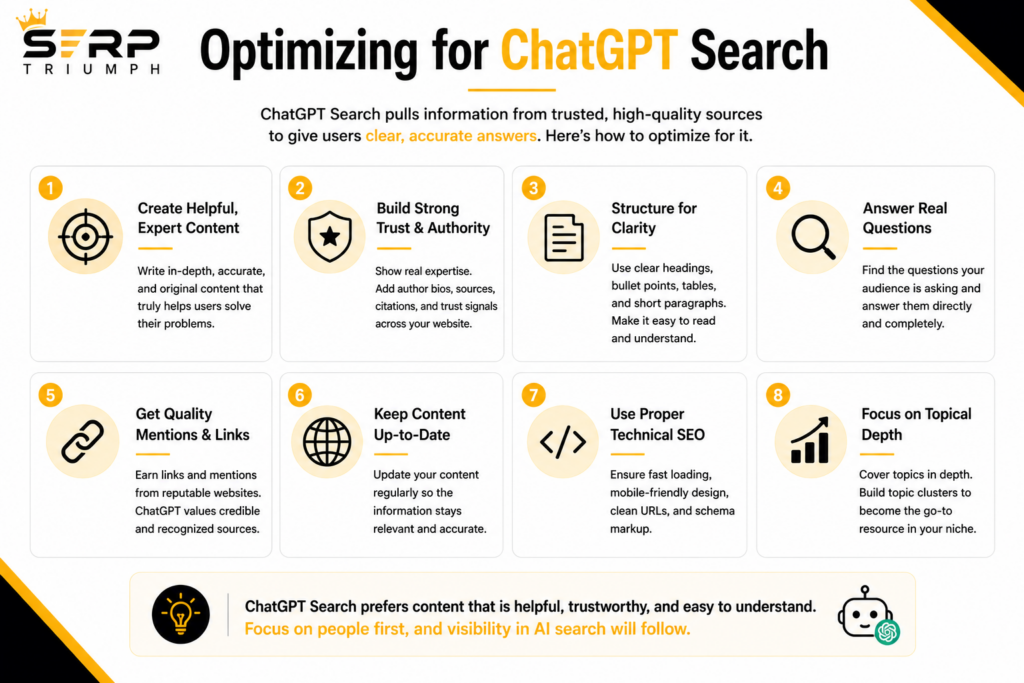
ChatGPT Search represents a new way users discover information. Rather than browsing multiple webpages, users ask conversational questions and receive detailed, synthesized answers. This changes how businesses should think about content creation. Instead of writing only for keywords, create resources that genuinely solve problems, explain concepts, compare solutions, and answer follow-up questions naturally.
Content Characteristics That Perform Well
- Clear introductions.
- Question-and-answer sections.
- Actionable recommendations.
- Real-world examples.
- Step-by-step explanations.
- Frequently Asked Questions.
- Updated statistics and industry insights.
Well-structured content is easier for AI systems to interpret, summarize, and reference when generating responses.
Optimizing Content for Google Gemini
Google Gemini powers many AI experiences across Google’s ecosystem. It emphasizes semantic understanding rather than simple keyword matching. Instead of asking:
“What keyword should I optimize?”
Ask yourself:
“Does this page completely solve the user’s problem?”
Comprehensive resources with logical organization, supporting examples, visuals, and internal topic relationships are far more valuable than thin pages targeting isolated keywords.
Microsoft Copilot and Bing AI Optimization
Microsoft Copilot integrates AI directly into Bing Search, Windows, and Microsoft 365 applications. As AI-assisted search adoption grows, businesses should optimize content for multiple search ecosystems rather than focusing only on Google. Copilot values:
- Authoritative content.
- Fresh information.
- Reliable citations.
- Helpful comparisons.
- Clear formatting.
- Topic completeness.
Creating evergreen resources alongside regularly updated articles helps improve visibility across AI-powered platforms.
Perplexity AI: Why Citations Matter
Perplexity AI has become one of the fastest-growing AI search platforms because it provides direct answers supported by source citations. Unlike traditional search engines, Perplexity encourages users to explore referenced sources, making high-quality content even more valuable.
To increase your chances of being cited by Perplexity AI:
- Publish original research and insights.
- Create detailed guides rather than short articles.
- Answer niche industry questions.
- Support claims with credible references.
- Keep information updated.
- Build topical authority through related content clusters.
Core GEO Ranking Factors
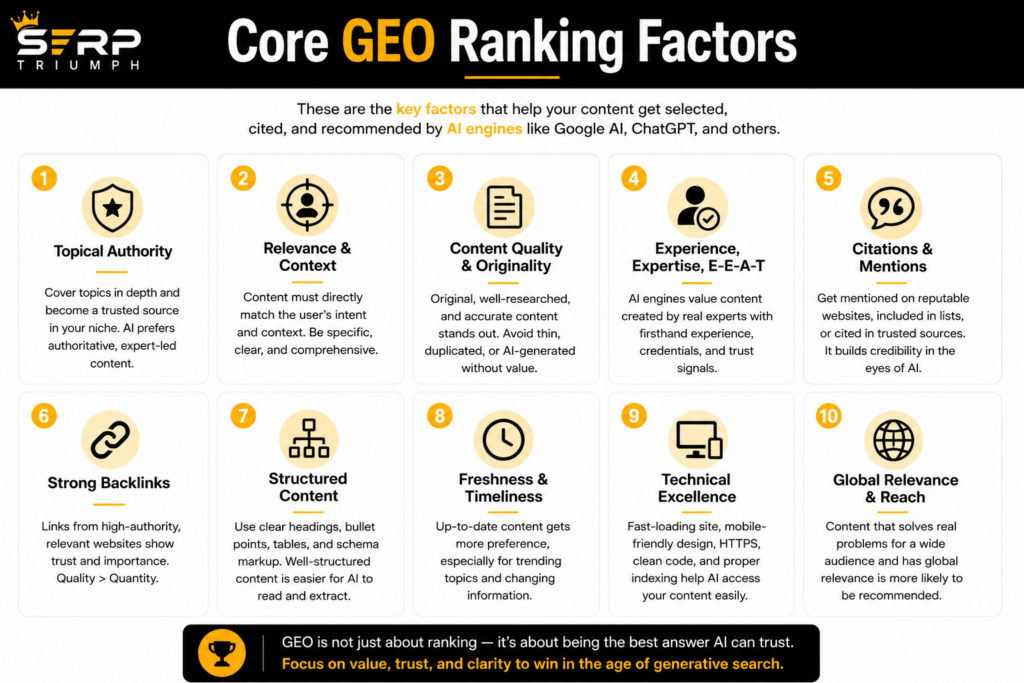
Although AI search engines use different technologies, they often evaluate similar quality signals when selecting information for generated responses.
1. Topical Authority
Publishing multiple interconnected articles around a subject demonstrates expertise. Rather than producing isolated blog posts, build comprehensive topic clusters that answer every stage of the user’s journey.
2. Semantic Relevance
AI systems understand relationships between concepts, entities, and topics. Include related terminology naturally throughout your content instead of repeating the same keyword excessively.
3. Content Freshness
Regularly updating articles with new examples, statistics, trends, and insights signals that your content remains relevant.
4. Structured Content
Use descriptive headings, bullet points, tables, summaries, and FAQs to make information easier for both users and AI systems to consume.
5. EEAT Signals
Experience, Expertise, Authoritativeness, and Trustworthiness remain essential. Include author information, case studies, testimonials, and transparent business details wherever appropriate.
Building a GEO-First Content Strategy
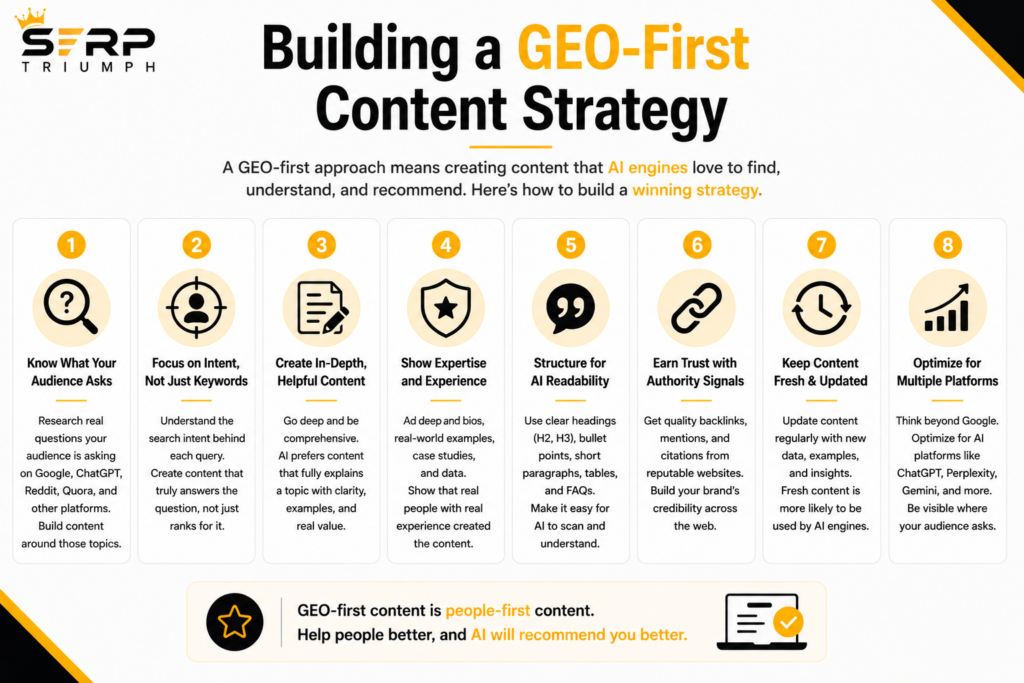
A successful GEO strategy begins long before publishing a single article. It requires understanding user intent, identifying topical gaps, and creating interconnected resources that answer every important question within your niche.
Instead of publishing random blogs, organize your website into content clusters supported by strong pillar pages. This structure helps AI systems recognize your expertise across an entire subject area.
Recommended Content Types
- Ultimate Guides
- Industry Statistics
- Case Studies
- Comparison Articles
- How-To Tutorials
- Checklists
- Templates
- Frequently Asked Questions
- Expert Roundups
- Glossaries
Why Internal Linking Is Essential for GEO
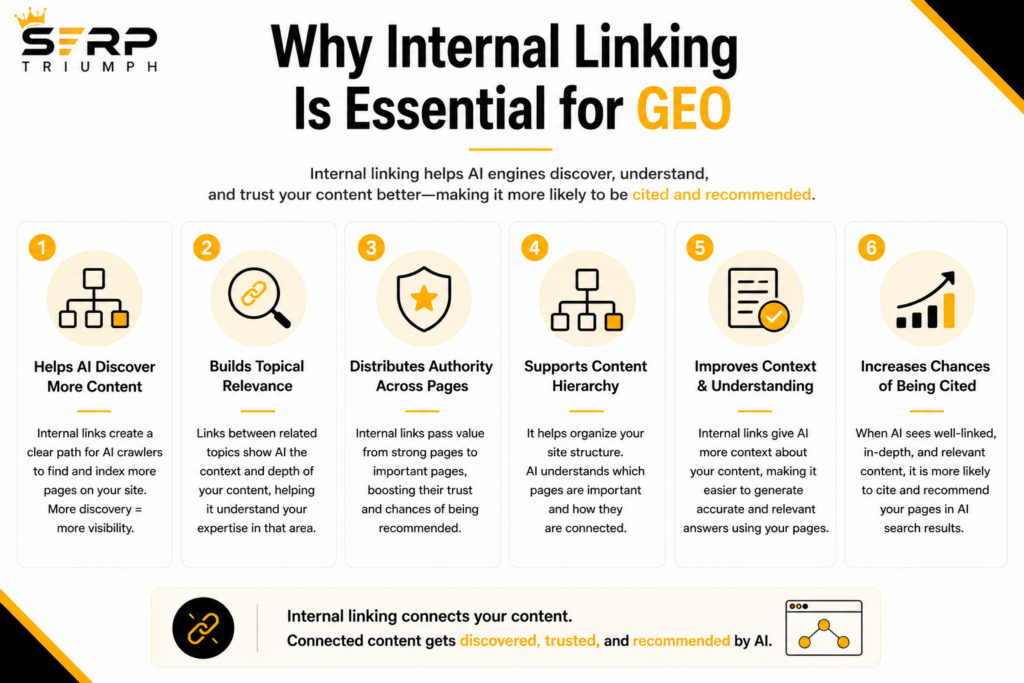
Internal links help AI systems understand the relationships between different pages on your website. A well-connected website improves crawlability, distributes authority, and strengthens topical relevance.
For example, if you’re exploring AI-focused SEO strategies, you may also benefit from our Digital Marketing Services, where we combine SEO, content marketing, paid advertising, and conversion optimization to create sustainable business growth.
Businesses investing in AI-ready websites should also explore our Web Design Services, which focus on responsive layouts, accessibility, and user experiences that support higher engagement and stronger search performance.
If your business relies on online sales, our eCommerce Development Services help create scalable online stores that are optimized for both traditional search engines and emerging AI search experiences.
How to Implement Generative Engine Optimization (GEO)
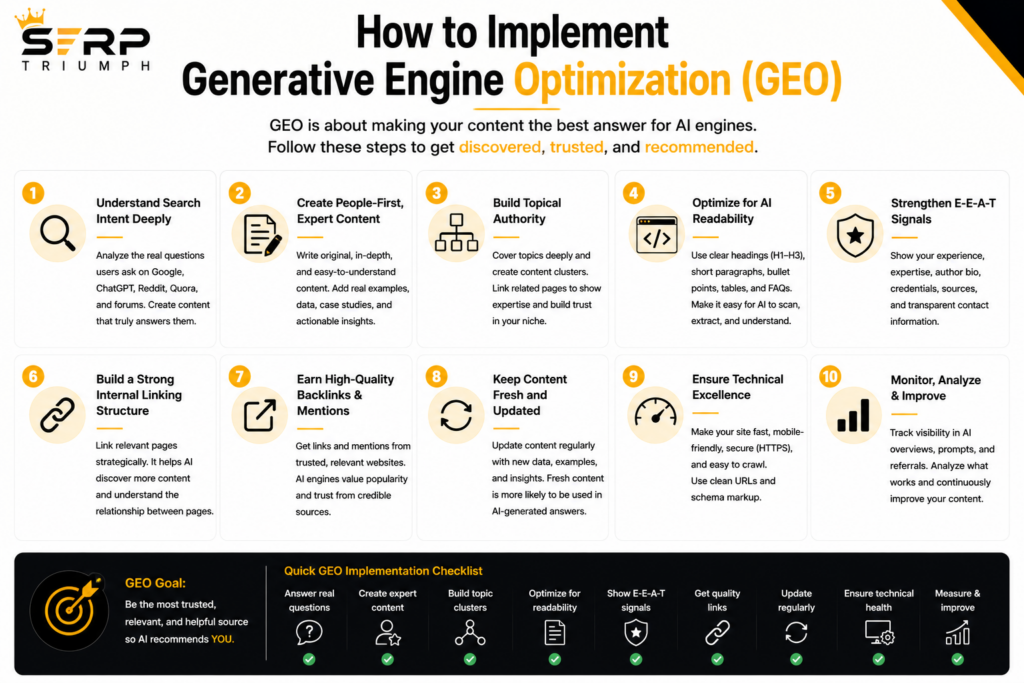
Building a successful GEO strategy requires more than publishing AI-generated articles. Businesses need a structured process that combines technical SEO, content strategy, semantic optimization, and continuous performance monitoring. Below is a practical implementation framework that can help your website improve visibility across Google AI Overviews, ChatGPT Search, Gemini, Microsoft Copilot, and other AI-powered search platforms.
Step 1: Perform Topic-Based Research Instead of Keyword Research
Traditional SEO begins with keyword research. GEO starts with understanding the complete topic. Instead of creating one page for a single keyword, build an ecosystem of interconnected content that answers every related question. For example, if your business provides SEO services, don’t publish only one article about SEO. Create supporting resources covering:
- Technical SEO
- Local SEO
- On-Page SEO
- Off-Page SEO
- Link Building
- Core Web Vitals
- Google AI Overviews
- Generative Engine Optimization
- Content Marketing
- SEO Audits
This approach demonstrates topical authority, one of the strongest signals AI systems use when selecting trustworthy sources.
Step 2: Create Helpful, Experience-Based Content
AI search engines increasingly prioritize content that reflects real-world expertise. Instead of repeating information already available online, share practical insights, case studies, lessons learned, original research, and actionable recommendations. Whenever possible, include:
- Real client examples
- Industry observations
- Data-backed recommendations
- Visual explanations
- Original screenshots
- Expert opinions
Content created from genuine experience is significantly more valuable than generic articles produced solely for rankings.
Step 3: Optimize Content Structure
AI models process structured information more effectively than large blocks of unorganized text. Every page should include:
- One clear H1 heading
- Logical H2 and H3 hierarchy
- Short paragraphs
- Bullet lists
- Comparison tables
- FAQs
- Summaries
- Actionable takeaways
A clean structure improves readability for users while making it easier for AI systems to understand and summarize your content.
Step 4: Strengthen Internal Linking
Internal links help search engines and AI models understand how different pages relate to one another. Every important service page should connect naturally with supporting blogs, guides, case studies, and industry resources. For example, businesses interested in increasing online visibility can explore our SEO Services, while companies looking for complete digital growth strategies can learn more about our Digital Marketing Services. Similarly, businesses planning to launch custom platforms can discover our Web Development Services, which focus on building fast, scalable, and search-friendly websites.
Why Schema Markup Matters for GEO
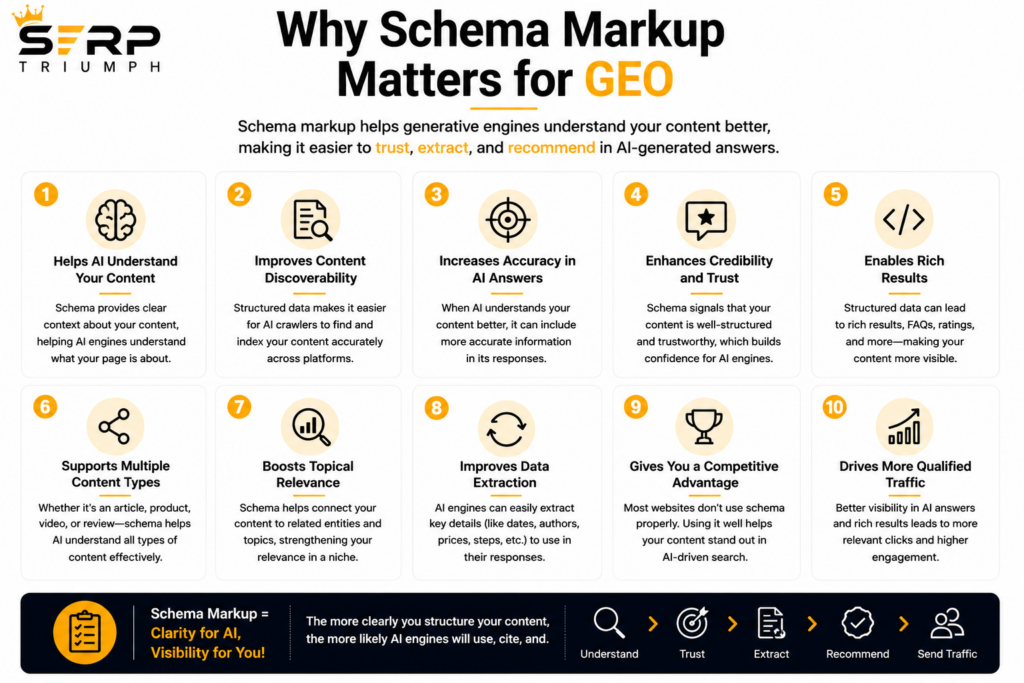
Schema Markup provides structured information that helps search engines understand the meaning and purpose of your content. Although schema does not directly guarantee AI citations, it improves machine readability and increases the likelihood that search engines correctly interpret your pages.
Recommended Schema Types
- Article Schema
- FAQ Schema
- Organization Schema
- Breadcrumb Schema
- Local Business Schema
- Service Schema
- Person Schema
- Review Schema
Using structured data consistently across your website supports both traditional SEO and AI-powered search experiences.
Technical SEO Still Matters
Generative Engine Optimization is built upon strong technical SEO. If your website loads slowly, has broken links, poor mobile usability, or indexing issues, AI search engines may struggle to access and trust your content. Important technical factors include:
- Fast page speed
- Mobile responsiveness
- HTTPS security
- XML Sitemap
- Robots.txt optimization
- Core Web Vitals
- Clean URL structure
- Canonical tags
- Image optimization
- Proper heading hierarchy
Regular technical audits ensure your website remains accessible, crawlable, and optimized for both search engines and AI systems.
Can AI-Generated Content Rank?
Yes—but only when it delivers genuine value. Search engines do not penalize content simply because AI assisted in its creation. Instead, they evaluate quality, originality, usefulness, and trustworthiness. Businesses should treat AI as a productivity tool rather than a replacement for human expertise. The most successful content combines:
- Human expertise
- AI-assisted drafting
- Professional editing
- Original examples
- Updated research
- Clear recommendations
This hybrid approach produces content that satisfies both users and AI-powered search systems.
Common GEO Mistakes to Avoid
- Publishing thin AI-generated articles without adding human expertise.
- Ignoring topical authority.
- Creating duplicate or repetitive content.
- Neglecting structured data implementation.
- Using outdated statistics.
- Poor internal linking strategy.
- Publishing without demonstrating expertise.
- Optimizing only for keywords instead of user intent.
- Ignoring technical SEO fundamentals.
- Failing to update evergreen content regularly.
The Future of Search Is AI-Assisted
Search is evolving from keyword matching to intelligent conversations. Users increasingly expect direct answers instead of browsing multiple webpages. As AI continues to improve, businesses that invest in trusted content, technical excellence, semantic optimization, and topical authority will be better positioned to earn visibility across every major search platform. GEO is not replacing traditional SEO—it is expanding its scope. Organizations that embrace this shift today will be better prepared for the future of digital discovery.
Benefits of Generative Engine Optimization (GEO) for Businesses
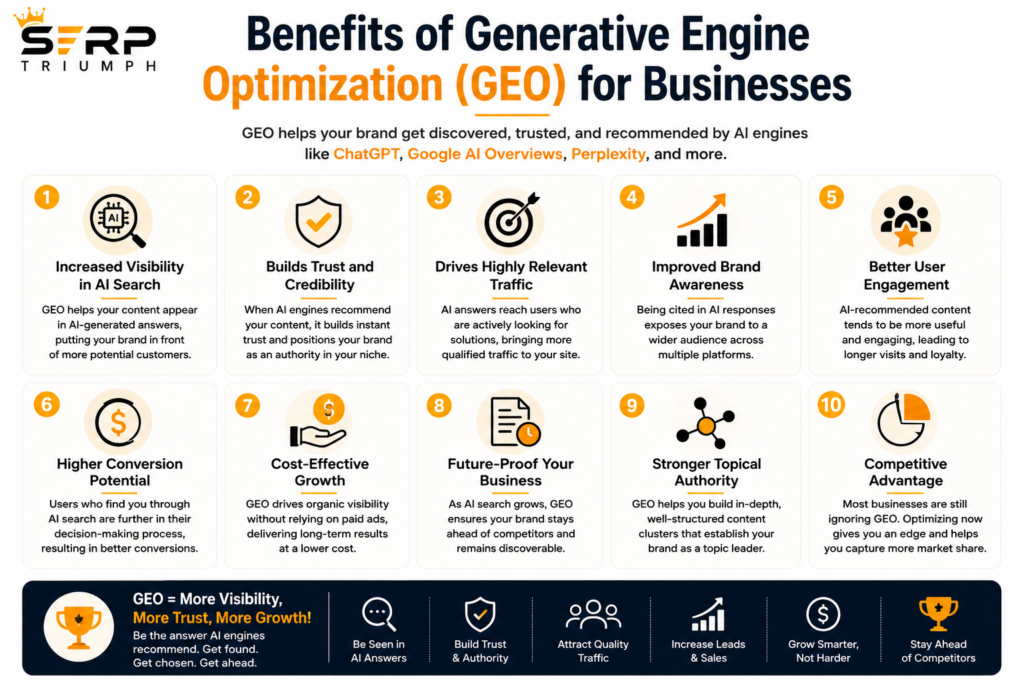
Generative Engine Optimization is more than a new SEO trend—it represents the next stage of digital visibility. As AI-powered search continues to evolve, businesses that adapt early can gain a significant competitive advantage. By optimizing your content for AI-generated answers, you improve your chances of being discovered by users across Google AI Overviews, ChatGPT Search, Gemini, Microsoft Copilot, Perplexity AI, and future AI-driven platforms.
Key Benefits of GEO
- Increase brand visibility in AI-generated search results.
- Build long-term topical authority within your industry.
- Improve trust and credibility through high-quality content.
- Support both traditional SEO and AI search optimization.
- Increase qualified organic traffic over time.
- Improve user engagement and content relevance.
- Future-proof your digital marketing strategy.
- Strengthen your online brand presence across multiple AI ecosystems.
- Generate higher-quality leads through intent-focused content.
- Stay ahead of competitors who rely only on traditional SEO techniques.
Complete GEO Optimization Checklist
Use the following checklist to evaluate whether your website is prepared for AI-powered search.
Content Optimization
- Publish original, high-quality content.
- Create comprehensive topic clusters.
- Answer user questions clearly.
- Use conversational language where appropriate.
- Include real-world examples.
- Update outdated content regularly.
- Add FAQs to important pages.
- Write compelling introductions and summaries.
- Optimize for search intent rather than keyword density.
- Avoid duplicate or thin content.
Technical Optimization
- Improve Core Web Vitals.
- Optimize page speed.
- Ensure mobile responsiveness.
- Use HTTPS.
- Submit XML sitemaps.
- Maintain a clean URL structure.
- Implement canonical tags.
- Fix broken links.
- Compress and optimize images.
- Maintain proper heading hierarchy.
Authority Building
- Earn high-quality backlinks.
- Build branded searches.
- Publish case studies.
- Collect client testimonials.
- Show author expertise.
- Display business credentials.
- Maintain consistent brand information.
- Strengthen topical authority.
- Increase brand mentions.
- Keep content factually accurate.
Schema Implementation
- Organization Schema
- Article Schema
- FAQ Schema
- Breadcrumb Schema
- Service Schema
- Local Business Schema
- Review Schema
- Person Schema
Why Choose SERP Triumph for Generative Engine Optimization?
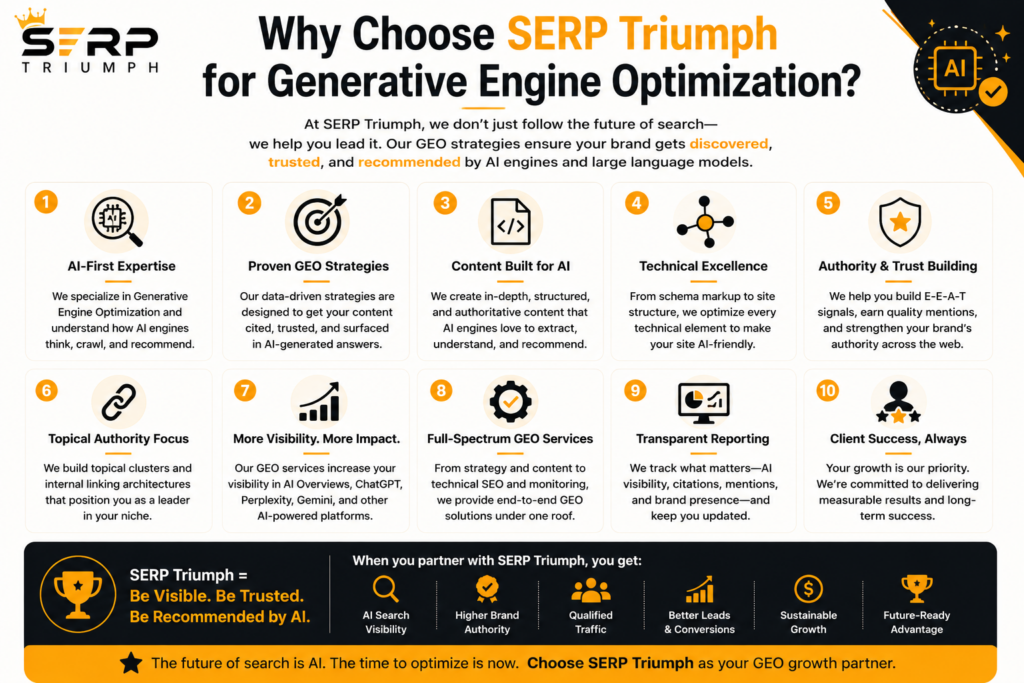
At SERP Triumph, we combine proven SEO strategies with modern AI search optimization techniques to help businesses improve visibility across both traditional search engines and emerging AI platforms. Our approach focuses on sustainable growth through technical excellence, high-quality content, structured data, topical authority, and user-focused optimization. Whether you’re a startup, local business, or enterprise, our team develops customized strategies designed to improve rankings, increase qualified traffic, and strengthen your online presence.
Our Core Digital Services
- SEO Services
- Digital Marketing Services
- Web Development
- Web Design
- Mobile App Development
- CMS Development
- eCommerce Development
- Contact Our Team
Final Thoughts
Artificial Intelligence is fundamentally changing how people search for information online. Instead of relying solely on traditional search results, users increasingly expect instant, trustworthy, and conversational answers. Generative Engine Optimization helps businesses adapt to this shift by creating content that is understandable, authoritative, and valuable enough to be referenced by AI systems. Organizations that invest in GEO today are preparing their websites for the future of search. Combining strong technical SEO, structured data, topical authority, helpful content, and continuous optimization will help your brand remain visible across Google AI Overviews, ChatGPT Search, Gemini, Microsoft Copilot, Perplexity AI, and future AI-powered search experiences.
Ready to Future-Proof Your SEO Strategy?
The future of search is already here. If your business wants to increase visibility across Google, AI Overviews, ChatGPT Search, Gemini, and other AI-powered platforms, now is the time to invest in a modern GEO strategy. SERP Triumph helps businesses build sustainable organic growth through advanced SEO, technical optimization, content marketing, and AI-ready digital strategies.
Let’s build an SEO strategy that’s ready for the future of AI Search.
Schedule Your Free Consultation →
Frequently Asked Questions (FAQs)
1. What is Generative Engine Optimization (GEO)?
Generative Engine Optimization (GEO) is the practice of optimizing website content so AI-powered search engines such as Google AI Overviews, ChatGPT Search, Gemini, Microsoft Copilot, and Perplexity AI can understand, trust, and reference your content when generating answers.
2. Is GEO replacing traditional SEO?
No. GEO is an evolution of SEO rather than a replacement. Traditional SEO remains essential for search rankings, while GEO expands optimization strategies to improve visibility in AI-generated search experiences.
3. Why is GEO important for businesses?
As AI-powered search continues to grow, users increasingly rely on direct answers instead of browsing multiple webpages. GEO helps businesses remain visible, build authority, and attract qualified traffic through AI-generated responses.
4. Which AI platforms should businesses optimize for?
Businesses should optimize their content for Google AI Overviews, ChatGPT Search, Google Gemini, Microsoft Copilot, and Perplexity AI while continuing to maintain strong traditional SEO practices.
5. Does GEO require different content than traditional SEO?
Yes. GEO emphasizes comprehensive, experience-driven, well-structured content that answers user questions completely rather than focusing only on keywords.
6. How does structured data help GEO?
Structured data helps search engines understand your content more accurately, making it easier for AI systems to interpret pages and potentially include them within AI-generated answers.
7. Can AI-generated content rank in search results?
Yes, provided it is original, accurate, well-edited, and genuinely helpful. Human expertise, fact-checking, and real-world insights remain critical for long-term success.
8. What role does topical authority play in GEO?
Topical authority demonstrates that your website provides comprehensive expertise on a subject. AI systems prefer trusted sources that consistently publish high-quality content covering an entire topic.
9. Is technical SEO still important?
Absolutely. Fast loading pages, mobile responsiveness, HTTPS, Core Web Vitals, structured URLs, and crawlability remain foundational for both traditional SEO and GEO.
10. What are the biggest GEO ranking signals?
Important signals include topical authority, semantic relevance, EEAT, structured data, content freshness, user engagement, internal linking, and website trustworthiness.
11. How often should GEO content be updated?
Evergreen content should be reviewed regularly and updated whenever industry trends, statistics, AI platforms, or best practices change. Fresh content improves credibility and relevance.
12. How does internal linking support GEO?
Internal linking helps AI systems understand relationships between pages, strengthens topical authority, improves crawlability, and distributes authority across your website.
13. Which industries benefit most from GEO?
Almost every industry can benefit, including healthcare, legal, finance, education, SaaS, eCommerce, local businesses, digital marketing agencies, real estate, manufacturing, and technology companies.
14. How long does it take to see GEO results?
Results vary depending on website authority, competition, content quality, and technical optimization. GEO should be viewed as a long-term strategy that strengthens visibility over time.
15. Why choose SERP Triumph for GEO services?
SERP Triumph combines technical SEO, AI-ready content strategies, structured data implementation, topical authority building, and advanced digital marketing expertise to help businesses succeed in both traditional and AI-powered search.
Take the Next Step with SERP Triumph
Whether you’re looking to improve your Google rankings, appear in AI-generated search results, or build a future-ready digital presence, SERP Triumph can help. Our team combines technical expertise, strategic content marketing, web development, and AI-focused optimization to create sustainable long-term growth for businesses across industries.
Explore our services, discover more educational resources, or contact our experts to discuss your business goals.